Boost your mental wellbeing
If you’re looking to improve your mental health and wellbeing, or want to support those around you, Beyond Blue has stories, tips and strategies to inspire you to achieve your personal best.
At Australia Post, we facilitate millions of connections each year. Our Post Offices and our people are at the centre of over 4,000 communities.
We’ve partnered with Beyond Blue to make mental health and wellbeing a part of everyday conversations and to build stronger, more connected communities. Our national network enables us to help Beyond Blue reach millions of individuals and businesses across Australia with mental health information.
Get tips on how to connect and look after your mental health from Beyond Blue.
Did you know nearly half of us will experience a mental health condition in our lifetime?
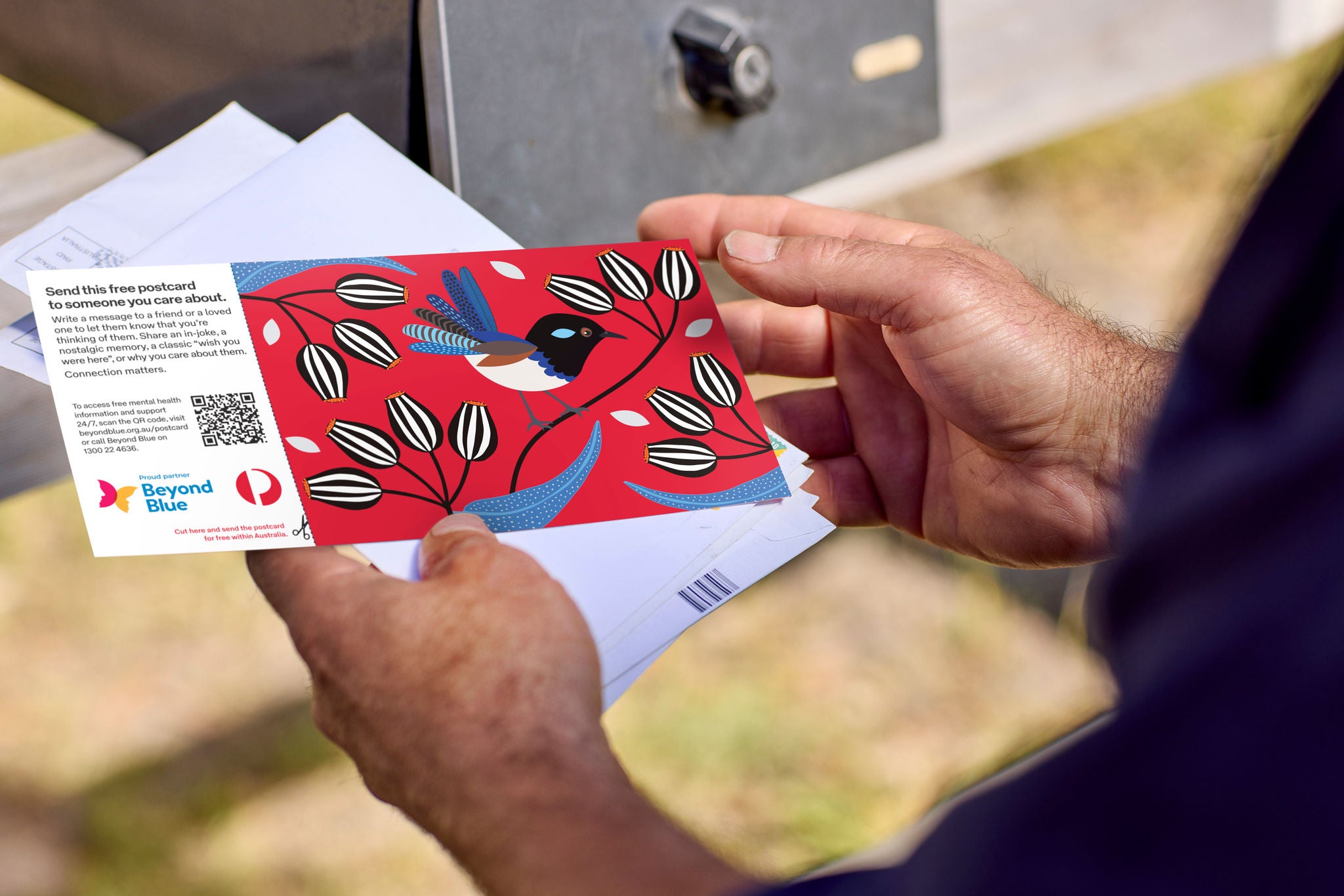
Feeling connected can make a difference. That’s why, together with Beyond Blue, we’re delivering millions of prepaid postcards to help people across Australia connect with each other.
In 2026, we’ll reach a milestone of delivering 25 million free Connection Postcards since 2021.
Video: Sunlight shines through leafy branches. In a country town, people walk towards a traditional building. A woman with long dark hair follows a garden path past a wood house. She reads a postcard that features an Australia Post logo. Text: "Nanna Moller, Postcard Recipient".
Audio: Nanna: I was walking in to my house and I checked my mailbox. I saw there was a postcard in there and turned it around and read it immediately and it said, "Hi, Nanna, I just wanted you to know that I really value our friendship and I was thinking of you and..." It's hard to put into words, like, just how...how that makes you feel. It just made me feel connected and valued.
Video: A document features a Beyond Blue logo. Text onscreen: "Australia Post and Beyond Blue are working together to reach millions of Australians with important mental health information and to encourage connection." A woman writes on a postcard that has been torn from the document along a perforated line. The postcard features colourful artwork of a fairy wren perched on a flowering plant. A dark-haired woman sits near an Australia Post banner. Text: "Nicky Tracey, General Manager, Community & Stakeholder Engagement, Australia Post."
Audio: Nicky: This initiative aims to raise awareness of mental health support and encourages people to take simple actions to look after their mental wellbeing, such as connecting with others to share a thought, a memory or a story.
Video: Nanna sticks the postcard on her fridge. One side has the heading 'When we connect, we feel better' above advice and contact details from Beyond Blue and Australia Post. A woman wearing a Beyond Blue butterfly logo on her blue blazer sits near a Beyond Blue banner. Text: "Georgie Harman, Chief Executive Officer, Beyond Blue." Sitting with a boy and an older woman, a man writes a postcard. He slips it into a post box.
Audio: Georgie: One in three Australians report feeling lonely and that's in a world and at a time where we've never been more connected digitally. But there's some disconnection between how we're living our lives and actually how we're feeling about our lives.
Video: In a town hall, a woman wearing red glasses writes at a communal table. She posts it in a little cardboard post box that sits on a table among Beyond Blue leaflets, wristbands and postcards. Text: "Jenny Holt, Community Member, Lockington."
Audio: Jenny: I wrote three postcards today to three close friends. So I'm just trying to connect with them because I haven't seen much of them lately. I hope they're going OK.
Video: In a post office, a blonde woman hands a Beyond Blue postcard to the worker behind the counter. A woman wearing an Australia Post name badge stands in a post office. Text: "Monica Bramley, Postal Manager, Church St Traralgon Business Centre."
Audio: Monica: It gives us a sense of joy to be able to offer this opportunity to families to be able to reach out and send letters and to touch somebody that might need a little pick-up.
Video: A postie stows a bundle of the postcards into a fluorescent yellow Australia Post carrier. He rides his motorbike from a car park. A man in an orange Australia Post safety shirt stands near shelves of boxes. Text: "Brett Eddy, Postal Delivery Coordinator, Australia Post."
Audio: Brett: Each year, we get a mailout with a postcard, and straightaway I see a difference in the staff. They get enjoyment out of delivering these postcards to...just to customers.
Video: A postie in yellow safety gear rides her bike to a letterbox and delivers a postcard. A man and boy examine a postcard. One side of the postcard has mirrored images of the fairy wren. On the other side, the top half has advice from Beyond Blue, and the bottom half has space to write. A woman wearing a Beyond Blue butterfly on her white blazer stands near a Beyond Blue banner. Text: "Nina Azzopardi, Head of People & Culture, Beyond Blue."
Audio: Nina: Connection is really important to maintaining good mental health. I think this campaign serves as a reminder to all of us that it's just so easy to send a postcard, just remind somebody that they're important to us, and that's really important to mental health.
Video: In a town hall, a banner has the words "When we connect, we feel better" above the Australia Post and Beyond Blue logos. At communal tables, people have morning tea and write postcards.
Audio: Georgie: With the high rates of mental health challenges and loneliness in Australia, this initiative is all about a meaningful way, a practical way, for people to show their support and connect with the people that they care about.
Video: Sitting on a garden bench, Nanna smiles as she holds her postcard. Text: "99% of people surveyed that sent the card said it had a positive effect on them." Standing by his motorbike, a postie smiles as he holds a postcard. Text: "Since the beginning of the partnership between Australia Post and Beyond Blue, over 16 million prepaid postcards have been distributed with a focus on regional and rural homes across Australia."
On the left half of the screen, the Australia Post logo appears on a red background. On the right half of the screen, the Beyond Blue logo and the words "Proud partner" appear on a white background.
Your donation will help Beyond Blue to:
There has never been a more important time to talk openly about mental health. Meet Beyond Blue volunteer speakers Fatimah, Jo and David who share their mental health journeys and talk about why connection matters to them. They’re encouraging people across Australia to connect with their friends, family, communities and culture and to have open conversations about mental health.
We open on a scene showing a work room filled with office accessories and books. The wall behind the work area is covered with images and hand drawn artwork. The following text is superimposed on the screen.
Fatimah is a Beyond Blue volunteer and small business owner who shares her journey with mental health to help others. Australia Post is proud to share her story with you.
We see Fatimah standing in front of an office window. An indoor plant is on the windowsill behind her. She is wearing a light blue jacket over a floral print dress.
She introduces herself.
My name is Fatimah.
The video scene transitions to Fatimah speaking to camera while seated at a large table.
I’m a career-driven professional that has been climbing the corporate ladder for the last 18 years until I stepped into my own business.
We see a new scene of Fatimah walking to an office desk and sitting down in front of a computer screen.
In 2007, I was successful in securing my first big role in the CBD. It was the weekend before, during dinner, I just had a sudden panic attack, I didn't know what it was.
As she speaks, we periodically cut away to see footage of Fatimah wearing casual clothes and walking her dog along a suburban street.
She continues:
So naturally my first instinct was “I’m about to die”. Then I remember going to the hospital, being on a drip for about four hours… and next day I had to get up and get ready to go to work on the Monday.
I was too scared to say anything and for many days later, concealing the fact that I had anything wrong with me; for the fear of losing my job after just starting.
The video now transitions to a new scene where we observe Fatimah through a window, standing on a deck surrounded by plants, and speaking on her phone.
She continues to speak. It was, in fact, related to underlying anxiety that I didn't know I had.
Once again, we see Fatimah seated at the large table and speaking to the camera before observing Fatimah through a window. She’s standing on a deck surrounded by plants and speaking on her phone.
Over the journey of recovery, I did learn how to manage. It almost doesn't affect me to a point where it stops me from doing anything that I want to do. In fact, it drives me to push harder than ever before.
We now see Fatimah moving across her room to sit at the table in front of her laptop computer.
Eight years into that corporate career, my first business, which didn't really go anywhere - kind of failed.
We see that the laptop screen shows six faces and a video conference is in progress.
All of the lessons from that, put into the last five years, have been a key part of our continued success more recently.
The video scene transitions between us observing Fatimah working at her laptop computer, and a view of Fatimah speaking to the camera. She continues to speak.
There's a lot of nervousness that comes around being a founder, and as we've been growing, the anxiety that comes with a growing business is continuing to come our way.
The video now shows someone writing into a notebook and cuts back and forth between observing the video conference and Fatimah working or speaking to the camera.
My team know mental health is a big part of what we do. We talk almost every single day. Even if we're not working, we're finding something funny to share with each other. Those sorts of connections that I’m making with people - it actually helps. I see the evidence firsthand.
If someone's feeling anxious and overwhelmed running a small business, stop what you're doing, take a step back. Think about what it is that's causing them that stress. You can then put in place strategies to overcome that.If it's financial stress - maybe it's looking at funding. If it's health stress - maybe it's getting your regular health check.
There's so many different things that you can do to overcome your anxieties, but you first need to acknowledge them and identify that they exist.
On screen, we see Fatimah and a man walking toward an office building and entering through the front automatic doors. They then walk to a reception desk. Fatimah continues to speak.
You have to talk about it. You have to find the triggers that are causing your anxiety. In my life. I’ve had everything from bullying to financial stress to personal health emergencies. But, understanding what the trigger is and then working to even mitigate that from happening in future is really key.
Fatimah and her male colleague speak to the receptionist and then we see them sitting down at a table in a meeting room.
I think sometimes we assume that having anxiety means that we're going to be any less good at our jobs; but it's actually quite the opposite. You need to make sure that you've got the time to take care of yourself because taking the time for self-care is what's going to help you to get through the next day, the next week, the next month.
We see Fatimah smiling to the camera. On screen, a title is superimposed over the footage. It reads – ‘When we connect, we feel better’. The scene then fades and is replaced by the Australia Post and Beyond Blue logos. The Australia Post logo is white and on a red background. This is on the left half of the screen, and the Beyond Blue logo is on a white background on the right half of the screen.
Video ends.
Fatimah, a small business owner, speaks about how vital it is for our mental health to open up and stay connected, something she encourages her staff to do.
In an open, well-lit room, we see a stylish woman with long brown hair, wearing a leather jacket over a dress. She is seated at a grand piano which is positioned near a large window. We see her reading music and playing the piano gently.
The following text is superimposed on the screen while she plays. Jo is a Beyond Blue volunteer and small business owner who shares her journey with mental health to help others. Australia Post is proud to share her story with you.
She introduces herself. My name’s Jo Blankfield. I have worked in a few different industries over the years. I like to be busy. I’ve got my own business. I’ve got music teaching and a little bit of performing. I’ve had about 17 years working in the fashion industry doing personal styling. Then I’ve got me, you know, taking care of myself.
As Jo speaks about herself we see video footage of her working in the various roles she is describing.
Anxiety was pretty much my midlife crisis at 21. I was at uni studying to be an opera singer. I knew exactly what I wanted. I knew where I was going. And then, all of a sudden, everything just sort of stopped. I could barely walk out my front door. I struggled to do day-to-day things.
Without speaking to professionals, without speaking to friends, without, you know, working through everything, I don't think I would have recovered from it, and I wouldn't be where I’m at now.
I’ve transitioned recently into health food and fitness because it became my passion and something that I really love and enjoy. As we listen to Jo speak, the video footage transitions and we see her now wearing latex gloves. With her hair tied back in a ponytail, Jo is seen packaging small cakes and pastries as she continues to tell her story in the kitchen.
It's so important that we connect to who we are, to what we do. In this day and age, I think we've become very much more focused on work as our identity, so if you don't connect to what you do, how can it then become a part of you and be something that you identify with?
After showing Jo closing the box of packed pastries, the video now transitions back to the earlier scene with Jo seated and speaking to the camera.
Treating your mental health as a part of your business and something that's going to help us succeed is really, really important. Set your business hours, set your boundaries. I’ve definitely made some big business decisions because I knew that it would start to create a lot of stress, a lot, and anxiety. It was very confronting walking away from a massive contract, but I did that with the support of people around me and I was very lucky to have that too.
Given the recent changes that have been happening, I’ve had to pivot a lot of things.
As she speaks, we see Jo viewing items on a laptop computer screen. I just had to step back, accept, use it as an opportunity to revisit how the business was functioning and really work through all those changes. As she describes the process of coping with change, we see video footage of Jo smiling as she carries shopping bags along a city street.
We then cut back to Jo speaking to the camera once again.
I try to talk to people. If I’m not feeling great, I’ll pick up the phone to a friend and I’ll say “Hey, having a bit of a crap day” and just talk through it; and all of a sudden, it gets a lot better.
The video footage now transitions back to the earlier scene where Jo is working in her kitchen and speaking to the camera. I would say to anyone else running a small business – “It'll be okay”.
We now transition to video footage of Jo with another lady, examining clothes and shoes in a clothing store. We hear her continuing to speak and transition to footage of Jo in the kitchen speaking about her experience. It might feel like the world is imploding and everything's going wrong, but actually, you're learning some of the best lessons you could possibly learn. You've just got to trust a little bit and just control what you can control.
We finish on video footage of Jo and the second lady in the clothing store examining high heel shoes and laughing together.
On screen, a title is superimposed over the footage. It reads – ‘When we connect, we feel better’. The scene then fades and is replaced by the Australia Post and Beyond Blue logos. The Australia
Post logo is white and on a red background. This is on the left half of the screen, and the Beyond Blue logo is on a white background on the right half of the screen.
Video ends.
As a small business owner, Jo speaks about how managing mental health by focusing on what you can control is important for success.
Video
Audio
The sea laps onto a rocky coastline which curves around to tree-covered cliffs. The Australia Post logo sits in a corner.
White text reads, "David volunteers his time as a Beyond Blue Speaker, sharing his journey with mental health to help others. We hope his story of connection is inspiring for you too."
Flowing music.
On a garden patio, a man with a white beard sits holding a black poodle. He's interviewed in a sitting room.
David Corduff:
My name is David Corduff. I'm a retired businessman. My passion is volunteering for organisations where I can hopefully make a little bit of a difference.
David sits and chats with his white-haired wife. They walk the dog along a tree-lined path, then a beach.
David Corduff:
First bout of depression came as a result of a retrenchment in my 30s. From there on, things didn't work out particularly well. I found myself losing interest in day-to-day things, sleeping poorly, my appetite had gone. I found a job that I should have been able to do easily became very, very stressful. I ended up in the hands of a psychiatrist and on medication to try and just stabilise me.
Smiling, David walks hand-in-hand with the woman. At home, they video call with a child.
David Corduff:
I went to see a whole series of different mental health professionals to try and find a cure. I realised maybe it's all about managing the depression. I used to be very reserved about anybody knowing how I was going because I was a bloke and I'm not supposed to feel down. And I realised as I got better, it was extremely important to maintain contact with people and also acknowledge the support of my family.
David goes through a box of family party photos. On a terrace, he laughs with his wife.
David Corduff:
My 60th was a very seminal day in my life. There were about 30 people there and the doors opened and it was "Happy birthday!" and I just froze. I thought, "No! God. I just don't want to be here. I don't want to do the social thing." My daughter basically, for want of a better description, outed me. She said, "I just want to tell you about Dad and his struggles over the last few years." There was a relief. A weight seemed to lift off my shoulders. I feel quite different now about being open and having whatever it takes to talk about mental illness.
In an office foyer, David and a white-haired man talk in a sitting area.
David Corduff:
Something I'm really passionate about is that guys need to communicate, not just on a minor level, just about themselves. I feel very lucky in terms of the voluntary stuff I'm doing now and I've got the facility of being able to talk to audiences. The more I sense that people get some sort of a message out of what I'm doing, the more energy it gives me.
As the sun sets, David and his wife gaze out to sea.
David Corduff:
I'm making a connection for me and it's part of my recovery too. You don't know whether you make a difference to people, but I'm sure as heck not going to stop trying.
On a white screen text reads, "Proud partner, Beyond Blue. beyondblue.org.au, 1300 22 4636."
The Beyond Blue logo is a red and orange butterfly.
The white Australia Post logo appears on a red screen.
Text reads, "When we connect we feel better."
Flowing music.
David shares how connecting and talking about his mental health condition has been a big part of his recovery.
If you’re looking to improve your mental health and wellbeing, or want to support those around you, Beyond Blue has stories, tips and strategies to inspire you to achieve your personal best.
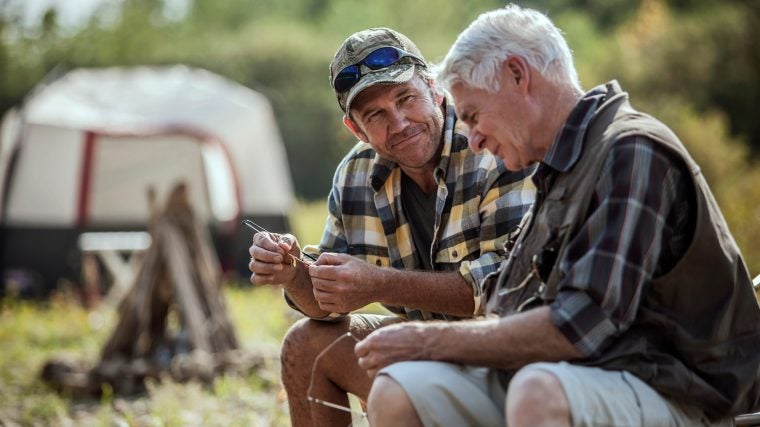
Are you going through a tough time, or worried about someone else? Starting the conversation is important but it can be hard. Beyond Blue has developed a range of resources to help you navigate this challenging topic.
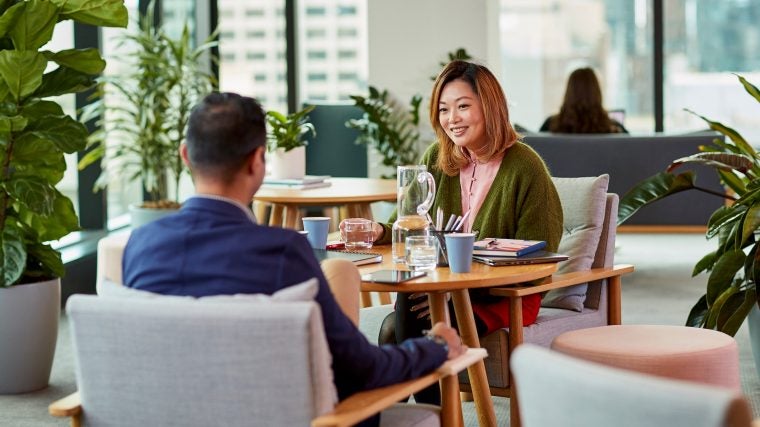
New Access for Small Business Owners, is a free and confidential mental health coaching program. It’s run by coaches with small business backgrounds and can help manage the stress that’s often associated with running a small business.
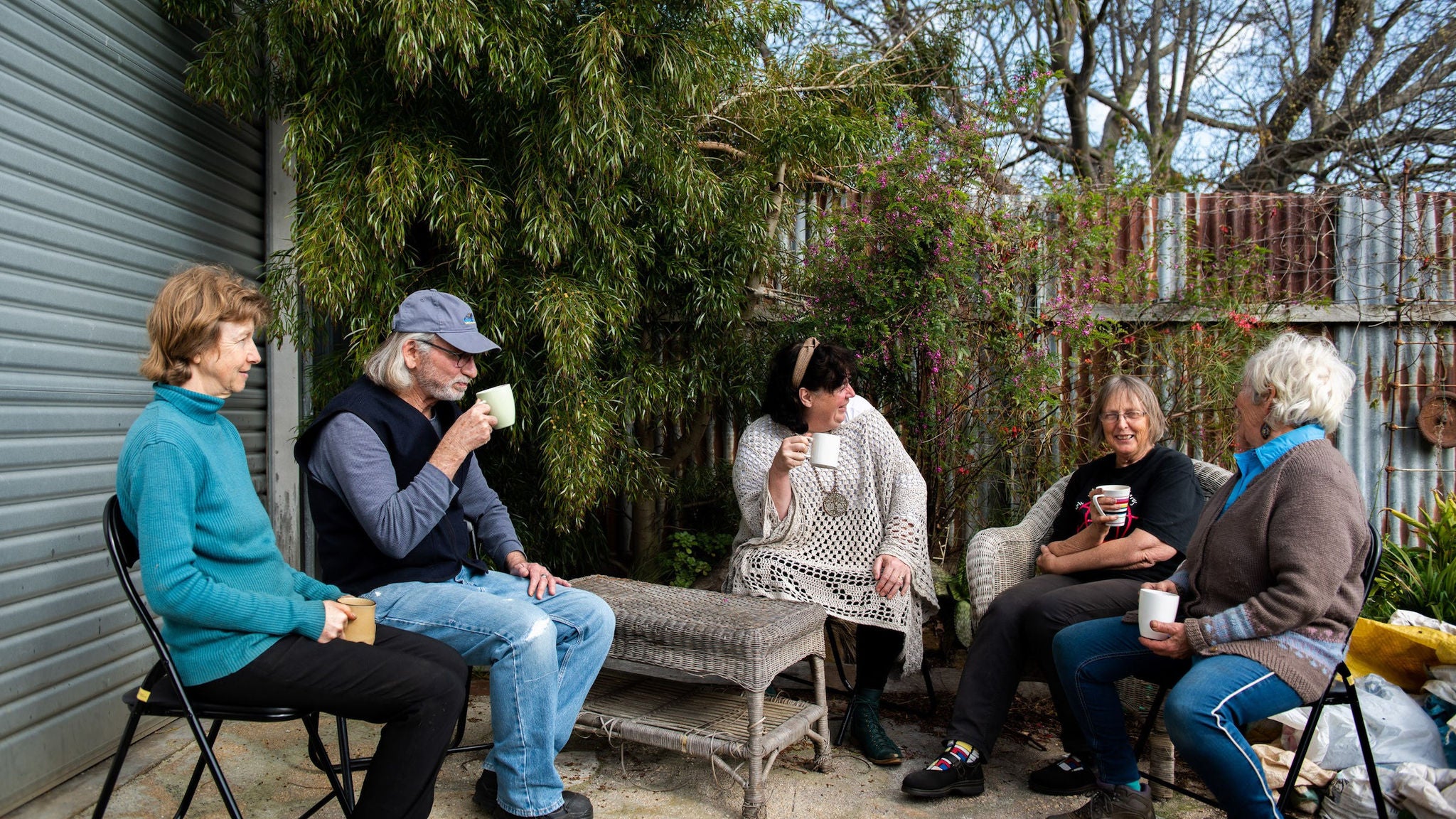
We’re helping organisations in every state and territory create meaningful connections to support mental health in their local community. Read about our Community Grants program, and learn about our grant recipients and their stories.