
Giving your clothes a second life
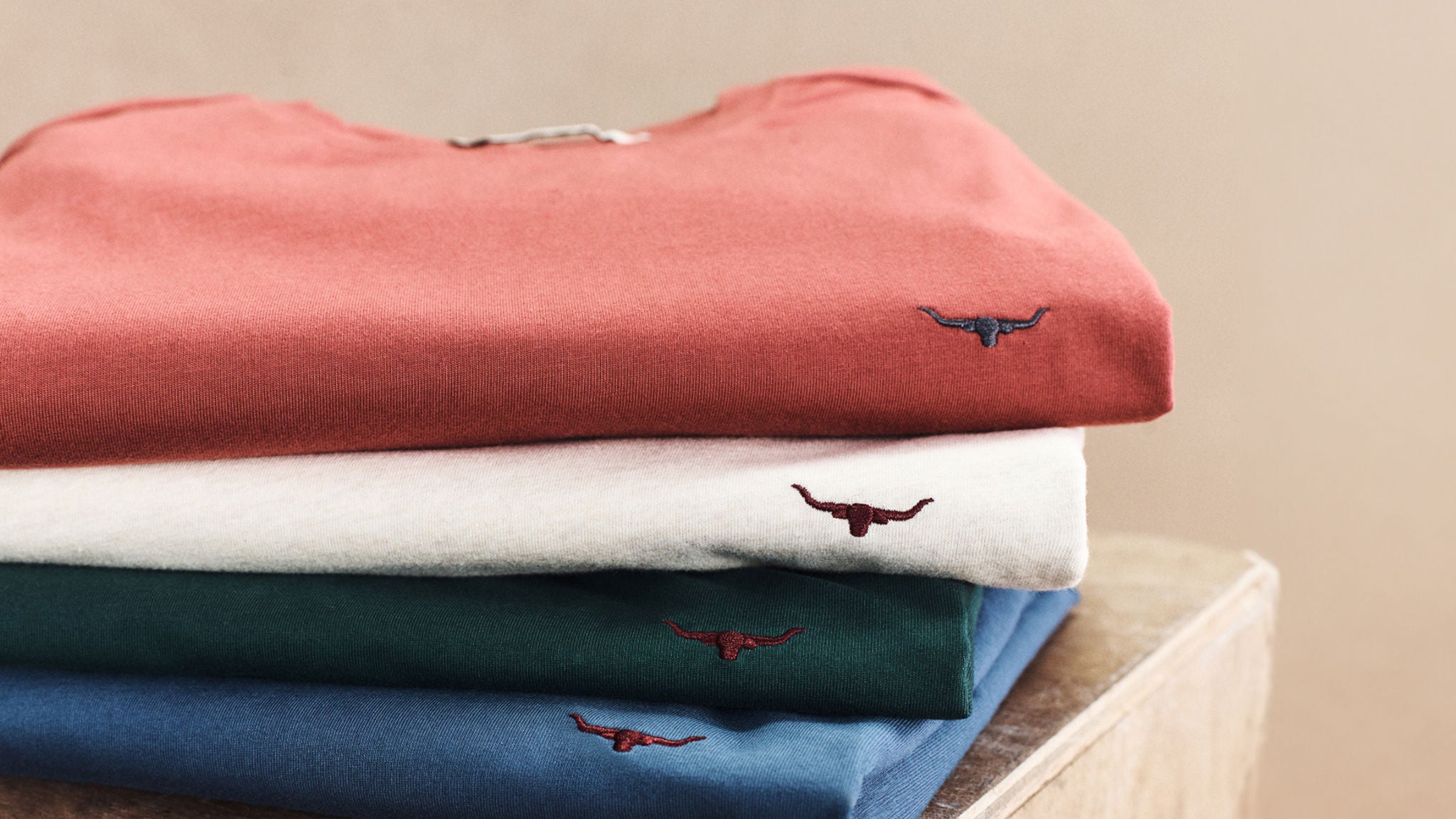
The circular satchel was part of a pilot for R.M. Williams’ customers to return old clothing for recycling through a traceable, circular system.
It was designed as a simple and easy way to make a positive impact on the environment, helping to address the more than 220,000 tonnes of textile waste that go to landfill in Australia each year.
How did it work? Customers could:
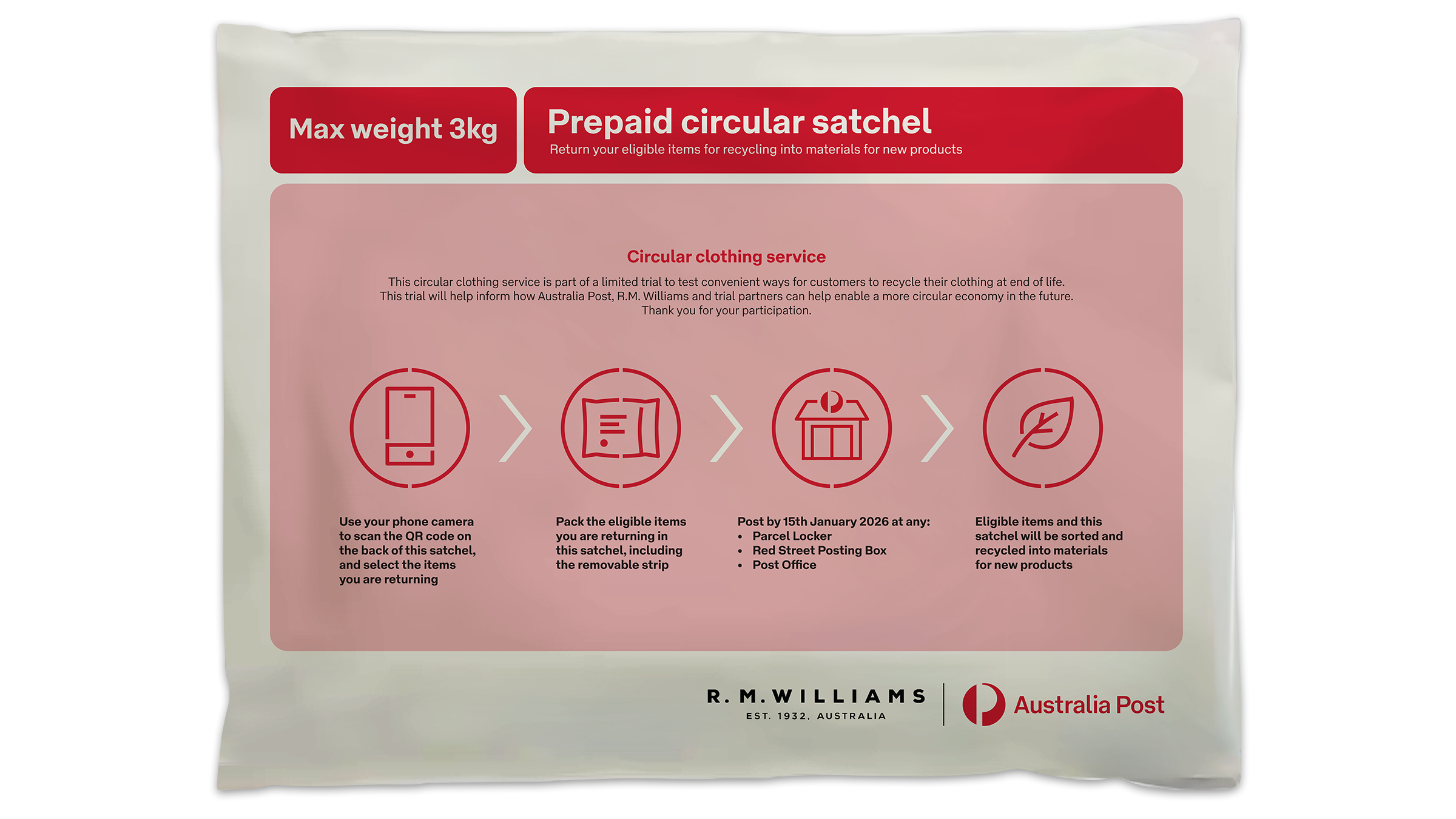
- Purchase: Add a circular satchel with your R.M. Williams' product order.
- Pack: Place eligible garments (t-shirts or shirts from any brand) in the satchel.
- Return: Drop off the satchel at any Australia Post Red Street Posting Box, Parcel Locker or Post Office.
- Transport: We send your satchel to our partners.
- Sorting: The satchel is opened, and its contents are sorted.
- Recycling: Items are processed and transformed into new materials.
- Re-use: These materials are used to make new products, giving them a second life.
The pilot program
We launched a pilot program for R.M. Williams’ customers with support from Seamless.
Seamless is Australia’s national clothing stewardship scheme, designed to tackle the growing problem of textile waste. Its goal is to help get clothing designed, used, reused, and recycled rather than ending up in landfill.
The pilot has wrapped up. It’s provided valuable insights as we continue to explore how our national infrastructure could make it easier for people to participate in a circular economy.
Turning an idea into action
The National Circular Textiles Pilot was a real-world trial designed to help create a more circular clothing economy in Australia.
Partnering with R.M.Williams, REMONDIS, BlockTexx, and iQRenew, this initiative shows how working together across industries can turn big ideas into real, practical solutions.
See how these ideas were tested, and how the service worked in practice, in the video below.
Read transcript
Audio (Marty Rowell): At Australia Post we have a bold ambition. To make circularity simple, accessible and scalable across Australia.
Video: Marty Rowell speaks to the camera.
Audio (Marty Rowell): To make circularity simple, accessible and scalable across Australia.
Video: Australia Post logistics in action: Parcels move through the Australia Post network, including delivery to a customer, unloading from a van, and moving along a conveyor belt.
Audio (Richard Pittard): Our circular clothing service pilot with R.M. Williams is a great example of circularity in action.
Video: Richard Pittard speaks to the camera.
Audio (Richard Pittard): Using our innovative, purpose designed satchel customers were able to return clothing that they no longer wanted through the Australia Post network.
Video: Circular Satchels are manufactured. A customer places unwanted clothing into a Circular Satchel and lodges it in a Street Posting Box.
Audio (Faina Kerr): This Pilot was made possible with support from the Seamless Circular Clothing Textiles Fund
Video: Faina Kerr speaks to the camera.
Audio (Faina Kerr): And delivered with R.M. Williams and partners including BlockTexx, REMONDIS and iQRenew.
Video: An R.M. Williams sign is shown. Workers in highvisibility clothing stand at the BlockTexx Textile Recovery Technologies facility. A REMONDIS banner is visible. A bale labelled iQRenew is shown.
Audio (Megan Priest): During this pilot program, when a customer is searching on our website
Video: Megan Priest speaks to the camera.
Audio (Megan Priest): they will get to the checkout with their item in the bag and they'll be offered recycle with R.M. Williams. If they select this item, it will add a Circular Satchel to their outgoing order.
Video: A customer browses the R.M. Williams website on a laptop and adds items to their shopping cart.
Audio (Megan Priest): If they select this item, it will add a Circular Satchel to their outgoing order.
Video: An R.M. Williams worker packs a customer order and includes a Circular Satchel.
Audio (Faina Kerr): We're proud to introduce the Circular Satchel, an innovation and first for Australia Post.
Video: Faina Kerr speaks to the camera.
Audio (Danial Gallagher): To make these satchels we have collected commonly wasted soft plastics from Australian households and processed them at our large scale spec facility. Once the satchel has completed its journey, it is collected and returned back to this facility where it is recycled once again.
Video: Danial Gallagher speaks to the camera. Bales of soft plastics are shown at a recycling facility. Soft plastics are shredded, processed through machinery, and formed into pellets.
Audio (Ben Hope): Once the satchels move through the postal network, they’re delivered to REMONDIS for receival and sorting.
Video: An Australia Post worker scans Circular Satchels and loads them into a delivery van.
Audio (Ben Hope): Our teams open the satchels, they assess the contents and then sort the textiles into defined pathways so the material can be reused or recovered appropriately.
Video: Ben Hope speaks to the camera. At a REMONDIS facility, workers open Circular Satchels, remove clothing, and inspect each garment. Sorted clothing is placed into separate Australia Post canvas bags.
Audio (Adrian Jones): When the product leaves REMONDIS its first port of call will be to go to one of our decommissioning partners. We will take the garments that are deemed to be unwearable, and we will use our chemical process to break those down into polyester and cellulose, PolyTexx and CellTexx, and then the PolyTexx will go onwards and go back into garments and the CellTexx will be used onshore for various agricultural or industrial uses.
Video: Adrian Jones speaks to the camera.
Audio (Adrian Jones): We will take the garments that are deemed to be unwearable, and we will use our chemical process to break those down into polyester and cellulose, PolyTexx and CellTexx, and then the PolyTexx will go onwards and go back into garments and the CellTexx will be used onshore for various agricultural or industrial uses.
Video: Used garments are shown. Recycled fibres are handled, inspected, and moved along conveyor belts. Pellets are produced. Forklifts move large bales of material inside the BlockTexx facility.
Audio (Megan Priest): Working with Australia Post to link everyone together has been an absolute game changer in terms of being the conduit to enable the full circular solution.
Video: A QR code on a Circular Satchel is scanned with a mobile phone, opening a website. People discuss the program at an event. Circular Satchels move along a conveyor belt into a truck.
Audio (Danielle Kent): It is exciting to work with Australia Post so that at Seamless we can understand what is possible as we are building a national clothing system into the future.
Video: Danielle Kent speaks to the camera. People talking to each other at an event.
Audio (Richard Pittard): We're proud to have partnered with such committed brands and stakeholders, and we're excited about what comes next.
Video: Workers in high visibility clothing pose for a photo holding a Circular Satchel. A demonstration is shown on a tablet. A group of people observe and discuss the demonstration.
Audio (Richard Pittard): As we continue to deliver for the future.
Video: Richard Pittard speaks to the camera.
The National Textiles Pilot evolved from our Circularity proof of concept. Together, they’re part of how we’re exploring ways our national infrastructure can make it easier for all Australians to participate in a circular economy. Stay tuned for more updates as we continue delivering for the future.
Read transcript
Audio (Richard Pittard): A lot of people talk about circularity and circular business models, but there's very few that actually exist.
Video: Richard Pittard speaks to the camera.
Audio (Richard Pittard): We realised at Australia Post that we had a unique opportunity to enable circularity in Australia, but we can't do it alone. The circularity proof of concept is a way of getting all of the value chain actors together and actually translating something from theory into practice. Let's see if we can make a circular business model stand up.
Video: Footage of the Australia Post building and a group of people mingling.
Audio (Marty Rowell): 220,000 tonnes of textiles end up in landfill every year.
Video: Marty Rowell speaks to the camera.
Audio (Marty Rowell): It's a significant problem that touches the whole population. It was a natural place to start.
Video: People smiling and talking to each other at an event.
Audio (Marty Rowell): Obviously, as Australia Post we support our customers in delivering clothing and apparel. What we're now looking to do is extend that to customers, to be able to return those items once they’re finished with them, and then to be able to close the loop and really address how we can minimise the number of products going to landfill and actually improve that customer experience as well.
Video: Parcels being placed on a conveyor belt and moving through a facility.
Audio (Megan Priest): For a consumer, they're shopping on our website, they get to the checkout, and there's a pop-up and an offer to the customer: Recycle with R.M. Williams.
Video: Megan Priest speaks to the camera.
Audio (Megan Priest): From there, this is intended to be maybe an R.M. Williams’ piece that they’ve had and loved and worn for many, many years, and it's come to the end of its life. So now with this proposed solution, they'll be able to receive a satchel from us directly with their next order.
Video: People smiling and talking to each other at an event and looking at garments on display.
Audio (Samantha Yap): With customer lodgement, the customer is going to get the satchel when they receive some freight.
Video: Samantha Yap speaks to the camera.
Audio (Samantha Yap): They're going to look in their closet or hopefully they've got something lying around that they do want to recycle and they're going to pop it in the satchel. From that point in time, they will scan a QR code. They'll pop their stuff in and on that QR code, they'll be taken to the Australia Post App where they can choose their lodgement.
Video: People demonstrating how to use your phone to lodge a parcel.
Audio (Charlene Fernando): Once the customer has lodged their articles digitally, we’ll either collect them from your home depending on the option you’ve chosen, which is a future state option, or we’ll collect them from a parcel locker, and they'll be processed through our facilities and proceed to the next step in our journey.
Video: Charlene Fernando speaks to the camera.
Video: Person demonstrating how to use your phone to track a parcel. A facility in operation.
Audio (Charlene Fernando): We want sustainability to be embedded at every stage of the journey. In terms of the packaging, we're looking at making them 100% recyclable.
Video: Charlene Fernando speaks to the camera.
Audio (Nathan Radley): When a satchel arrives at Remondis, essentially, we're doing a sorting and verification process.
Video: Nathan Radley speaks to the camera.
Audio (Nathan Radley): Our process is basically to quickly open and sort the package, identify any contamination and send the material off to its destination as quickly and efficiently as possible.
Video: A person holding and looking at a satchel and talking to other people.
Audio (Adrian Jones): We will receive the material from Remondis, and then it will be re-sorted into the fibre type and then shredded.
Video: Adrian Jones speaks to the camera.
Audio (Adrian Jones): It arrives at our plant where, through a chemical process, we’ll separate it into its building blocks of polyester and cellulose. The polyester can be converted back into textiles, so it can go back into clothing, and the cellulose will always go back into a hydro-mulch.
Video: An iPad displaying footage of material being shredded at a facility.
Video: People smiling and talking to each other at an event.
Video: Marty Rowell speaks to the camera.
Audio (Marty Rowell): From here, we'll continue to work with the brands. We'll look at how we can extend this from just a proof of concept into a real-life pilot.
Video: People smiling and talking to each other at an event.
Audio (Richard Pittard): There's been some really unique learnings through this process.
Video: Richard Pittard speaks to the camera.
Audio (Richard Pittard): I'm really excited for putting those learnings into practice and to stand up a truly circular business model in Australia. This is all about collaboration and innovation at its best. It's about Australia Post helping its customers to deliver circular solutions and to create value for all Australians. This is about delivering for the future.
Video: People smiling and talking to each other at an event.
Audio (Richard Pittard): This is about delivering for the future.
Video: Richard Pittard speaks to the camera.